service@lencolo37.com |
+86 18027002837(WhatsApp)

Search for Products.
Anti-graffiti coatings are designed to resist a wide range of contaminants, including oil-based markers, spray paints, grease, asphalt residues, and resin- or dye-based pigments. For these substances to become difficult to remove, they must spread across the surface, penetrate into the coating, and form stable adhesion. True anti-graffiti performance works by disrupting all three steps simultaneously.
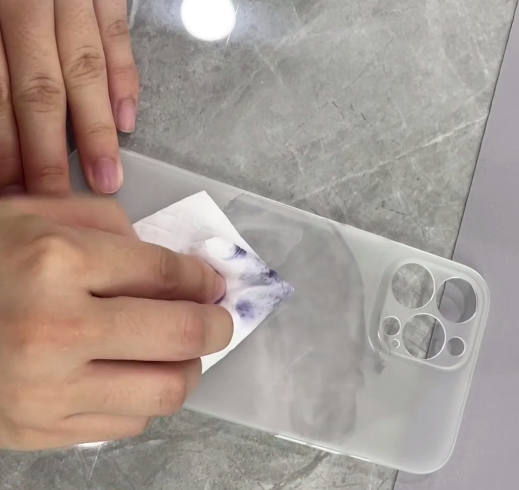
Lowering surface energy primarily affects how contaminants behave upon contact. It increases the contact angle, reduces wetting, and minimizes the contact area, making it harder for substances to spread. While this is a critical first barrier, it only addresses surface wetting—not the full challenge of long-term stain resistance or cleanability.
Even when contaminants cannot spread easily, they may still penetrate microscopic surface structures or interact strongly with surface groups. In such cases, removal becomes difficult despite low surface energy. Effective anti-graffiti systems must therefore go beyond wetting control and also limit penetration and adhesion.
Initial performance can degrade if the low surface energy components are not stable. In many systems, these components rely on migration or surface enrichment, which can be lost during cleaning, abrasion, or weathering. Durable anti-graffiti coatings ensure that low-energy structures are permanently integrated into the cured film.
High-performance solutions embed low-energy components directly into the coating network during film formation and curing. This prevents them from being washed away or redistributed over time, turning anti-graffiti performance from a temporary surface effect into a long-lasting material property.
Anti-graffiti performance is not driven by additives alone—the resin system provides the foundation. A well-designed matrix offers low affinity to contaminants, high film density, strong chemical resistance, and excellent scrub durability. In advanced coatings, anti-graffiti becomes an inherent system property rather than an isolated feature.
In real applications, anti-graffiti performance is closely linked with slip, anti-blocking, flow, leveling, and surface uniformity. These properties all originate from how the surface is structured and how interfaces behave. As a result, effective solutions are built through holistic surface engineering rather than single-point optimization.
A common misconception is that anti-graffiti coatings prevent anything from sticking at all. In practice, the goal is to ensure that contaminants cannot form strong, lasting adhesion. They may contact the surface, but the interaction remains weak, allowing for easy and complete removal during cleaning.
Anti-graffiti effectiveness depends on multiple factors working together: appropriate surface energy, a dense and resistant top layer, weakened interfacial interactions, stable low-energy composition, and a controlled surface state. Focusing on just one parameter may look good in data, but only a balanced system delivers reliable real-world performance.
Anti-graffiti is not a standalone feature—it is the result of integrated material design. By aligning surface chemistry, structure, and stability, modern coatings can deliver consistent cleanability and long-term protection in demanding environments.
#AntiGraffiti #AntiGraffitiCoating #EasyCleanSurface #SurfaceProtection #CoatingTechnology #AdvancedCoatings
#FunctionalCoatings #LowSurfaceEnergy #SurfaceEngineering #MaterialsScience #IndustrialCoatings
#ProtectiveCoatings #DurableCoatings #SmartCoatings #SurfaceInnovation #Cleanability #StainResistance
#ChemicalResistance #HighPerformanceMaterials #CoatingSolutions

2025-01-06

2022-08-03