service@lencolo37.com |
+86 18027002837(WhatsApp)

Search for Products.
In UV curing, one frustrating scenario keeps showing up: the coating looks perfect, feels completely dry, and passes every visual check—yet fails the cross-hatch test instantly. It challenges intuition. If it's dry, how can adhesion still be poor? The truth is simple but often overlooked: in UV systems, "dry" does not equal "bonded."
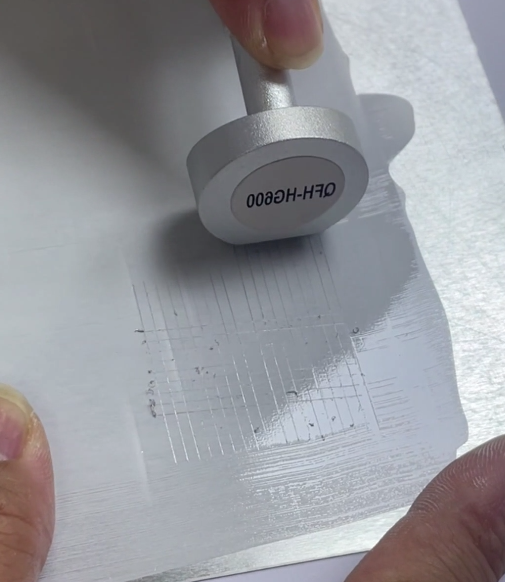
Glossy finish, smooth leveling, no tack, solid hardness—everything points to success. These surface signals are reassuring, but they can also be misleading. They only confirm that a film has formed on top, not that it has anchored below. Many UV failures happen precisely because everything looks right.
Real adhesion happens at the microscopic interface between coating and substrate. This is the one place you can't judge by touch or sight. If that interface isn't properly formed, the coating becomes nothing more than a "floating layer"—intact on the surface, but fundamentally unconnected underneath.
A coating may feel hard, resist scratches, and look flawless—but one cross-hatch cut and a strip of tape can expose everything. When adhesion fails, it fails fast. What seemed like a strong film suddenly lifts off, proving that surface performance alone is never the full story.
When failure occurs, the first instinct is to increase UV energy or extend exposure time. But in many cases, the coating is already fully cured. The issue isn't under-curing—it's under-bonding. More energy won't fix a missing connection at the interface.
Low surface energy materials—like plastics, films, metals, or glass—are naturally difficult to bond. If the coating cannot properly wet and penetrate the substrate surface, it simply sits on top. The result? A visually perfect coating that is structurally unstable from the start.
Speed is a major advantage of UV curing—but it can also be a hidden risk. When curing happens too quickly, especially at the surface, the coating locks into a rigid structure before it has time to form a strong bond with the substrate. It cures fast—but attaches weakly.
Highly reactive systems and high crosslink density formulations often deliver excellent surface properties—fast cure, high hardness, great feel. But they can sacrifice adhesion. The coating becomes strong within itself, yet poorly connected to what matters most: the substrate.
UV curing inherently involves shrinkage. When this shrinkage is too rapid or too intense, it creates internal stress. If that stress exceeds the bonding strength, the coating can literally pull itself off the substrate. This is why some coatings pass initially but fail hours later or after heat exposure.
Sometimes the coating isn't the problem at all. Contaminants like oils, release agents, fingerprints, or degraded surface treatments can completely block adhesion. These issues are often invisible, but they silently undermine performance. What looks like an adhesion failure may actually be a preparation failure.
This is the core misconception: forming a dry, solid film does not guarantee adhesion. Film formation is just the first step. True performance depends on whether that film has established a stable, lasting bond with the substrate.
Instead of asking "Is it fully cured?" the better question is:"Why didn’t it bond?"This shift in thinking is what separates quick fixes from real solutions.
Reliable UV performance starts at the interface—not the surface. By optimizing substrate treatment, improving wetting, balancing cure speed, and controlling internal stress, you ensure not just a coating that looks good, but one that stays put. Because in the end, true quality isn't how dry it feels—it's how well it holds.
#UVCuring #UVCoatings #AdhesionFailure #CrossHatchTest #SurfaceVsInterface #CoatingTechnology #IndustrialCoatings #UVInk #UVAdhesion #MaterialScience #CoatingDefects #SurfacePreparation #LowSurfaceEnergy #CuringProcess #UVFormulation #CoatingPerformance #AdhesionTesting #ManufacturingQuality #ProcessOptimization #UVIndustry

2025-01-06

2022-08-03