service@lencolo37.com |
+86 18027002837(WhatsApp)

Search for Products.
Poor adhesion is one of the most common challenges in UV coating applications.Even when a coating achieves excellent gloss, hardness, and curing speed, it may still fail cross-hatch, tape, or water resistance tests if adhesion is insufficient.
Below are five common causes of adhesion failure on plastic substrates and practical solutions to improve coating performance.
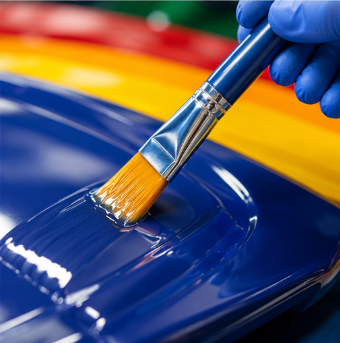
Low Surface Energy of Plastic Substrates
PP, PE, and TPU are difficult substrates for UV coatings due to their low surface energy. Poor wetting prevents the coating from forming a strong bond, often resulting in weak adhesion and failure during cross-hatch, tape, or water resistance testing, even when the cured film initially appears intact.
Solutions:
· Corona treatment
· Plasma treatment
· Flame treatment
· Adhesion-promoting UV resins and additives
Surface Contamination and Mold Release Residues
Residual mold release agents, silicone, wax, or oil on plastic surfaces can interfere with coating adhesion. Without proper surface cleaning, UV coatings may bond to the contaminant layer instead of the substrate, causing adhesion failure.
Solutions:
· Solvent cleaning
· Air blowing
· Surface inspection and contamination control
· Collaboration with molding suppliers to reduce release-agent residue
Excessive Cure Shrinkage and Internal Stress
UV coatings cure through rapid polymerization and crosslinking reactions. While fast curing improves productivity, excessive crosslink density can generate significant shrinkage stress within the coating film. As the coating contracts during curing, stress develops at the coating-substrate interface. If this stress exceeds the system's adhesion strength, defects such as cracking, lifting, or delamination may occur.
Solutions:
· Optimize oligomer and monomer selection
· Reduce excessive crosslink density
· Balance hardness and flexibility
· Use low-shrinkage UV resin systems
Poor Wetting and Flow
Proper wetting is essential for strong UV coating adhesion. Low substrate surface energy, contamination, or unsuitable coating surface tension can prevent the coating from fully wetting the surface. As a result, insufficient interfacial contact may occur, leading to reduced adhesion strength, lower durability, and potential coating failure.
Solutions:
· Optimize coating surface tension
· Use wetting and leveling additives
· Improve substrate compatibility
· Evaluate recycled or engineered plastic surfaces carefully
Lack of Adhesion-Promoting Chemistry
Many UV formulations are designed to maximize hardness, gloss, chemical resistance, or curing speed. However, adhesion is often overlooked during formulation development.Without suitable adhesion-promoting chemistry, the coating may have excellent mechanical properties but insufficient interaction with the substrate surface. This problem becomes particularly evident on difficult plastics such as PP, PET, vacuum-metallized plastics, and certain engineering plastics.
Solutions:
· Incorporate adhesion-promoting monomers
· Use specialty adhesion additives
· Select substrate-specific UV oligomers
· Optimize formulation for long-term durability
#AdhesionPromoter #SurfaceChemistry #MaterialScience #ChemicalInnovation #AdvancedCoatings #rawmaterial#UVadhesion#UVCuring #AdhesionFailure#Chemicalmaterial
#UVCoatings #BondingSolutions #IndustrialChemicals
#SmartMaterials #StickBetter #NoPeeling #StrongBond #CoatingTechnology#BetterAdhesion #DIYCoatings #ResinTips

2025-01-06

2022-08-03