service@lencolo37.com |
+86 18027002837(WhatsApp)

Search for Products.
Lencolo
2026-06-29
Plastic substrates such as ABS, PC, PMMA, PET, PVC, and TPU have become increasingly important in industries including consumer electronics, automotive interiors, household appliances, packaging, and decorative films.
While UV-curable coatings provide excellent appearance, fast curing, and high production efficiency, achieving strong and durable adhesion on plastics remains one of the most common challenges faced by coating formulators.
Poor adhesion can result in peeling, cracking, edge lifting, or coating failure during processing and long-term use.
Fortunately, adhesion is rarely determined by a single material. Instead, it depends on the interaction between the substrate, resin system, additives, curing conditions, and surface treatment.
Understanding these factors can significantly improve coating reliability and product performance.
Many plastic substrates naturally have low surface energy, making it difficult for UV coatings to wet the surface properly.
Materials such as PP, PE, and certain engineering plastics often require surface activation before coating.
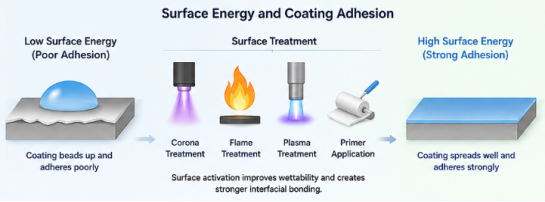
Common pretreatment methods include:
· Corona treatment
· Flame treatment
· Plasma treatment
· Primer application
Proper surface preparation improves coating wetting and creates stronger interfacial bonding between the substrate and the cured coating.
The resin system is the foundation of UV coating performance.
Different resin chemistries provide different adhesion characteristics:
· Polyurethane acrylates offer excellent flexibility and strong adhesion on plastics.
· Epoxy acrylates provide high hardness and chemical resistance.
· Polyester acrylates balance flexibility, hardness, and cost.
· Modified acrylic resins can improve compatibility with difficult plastic substrates.
Selecting the appropriate resin architecture helps achieve both reliable adhesion and long-term mechanical performance.
Reactive diluents influence much more than coating viscosity.
A properly designed monomer system affects:
· Surface wetting
· Penetration
· Crosslink density
· Shrinkage stress
· Flexibility
Excessive shrinkage during UV curing may generate internal stress that weakens adhesion, especially on flexible plastic films.
Using balanced monomer combinations helps minimize stress while maintaining hardness and curing efficiency.
Although additives are used in relatively small quantities, they play an important role in coating stability and adhesion.
Typical additives include:
· Wetting agents for improved substrate coverage
· Defoamers for smooth film formation
· Flow modifiers for better leveling
· Adhesion promoters for difficult substrates
Proper additive selection improves coating uniformity without negatively affecting curing performance.
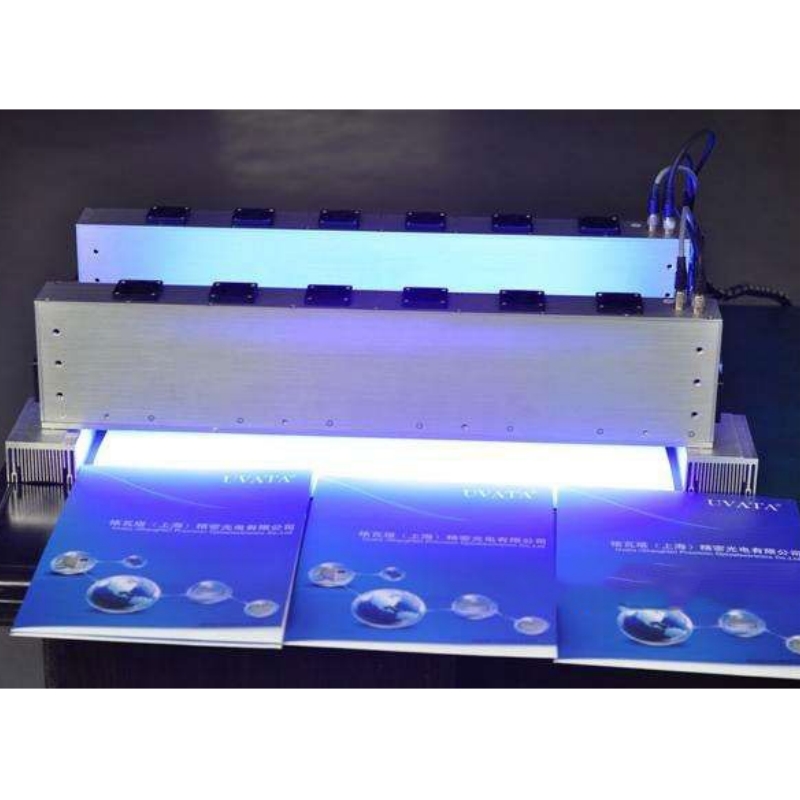
Even an excellent formulation may fail if curing conditions are not properly controlled.
Key parameters include:
· UV lamp intensity
· Exposure time
· Coating thickness
· Photoinitiator compatibility
· Oxygen inhibition
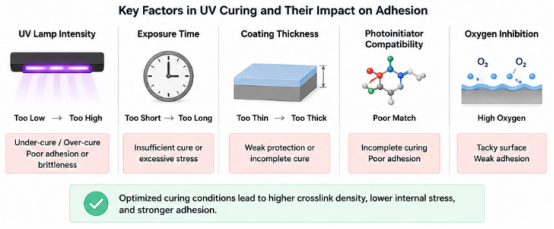
Insufficient curing reduces crosslink density, while excessive curing may increase internal stress and brittleness.
Optimizing curing parameters is essential for achieving maximum adhesion and coating durability.
Laboratory adhesion tests provide valuable information, but real-world performance should always be considered.
Depending on the final application, coatings may need to withstand:
· Temperature cycling
· Humidity exposure
· Chemical cleaners
· Abrasion
· Impact
· Long-term outdoor weathering
Comprehensive testing helps ensure stable adhesion throughout the product lifecycle rather than only immediately after curing.
Modern UV coating systems are widely used on:
· Mobile phone and tablet components
· Automotive interior trim
· Vacuum metallized plastics
· Decorative panels
· PET and PC films
· Household appliance housings
· Cosmetic packaging
· Electronic devices
Each application requires a different balance between adhesion, hardness, flexibility, appearance, and processing efficiency.
Strong adhesion is not achieved by a single raw material.
Instead, it results from the careful optimization of resin selection, reactive monomers, additives, substrate preparation, and curing conditions.
As UV coating technology continues to evolve, formulators increasingly focus on complete system design rather than individual material performance. This integrated approach not only improves adhesion but also enhances scratch resistance, chemical durability, and long-term reliability across a wide range of plastic substrates.
Whether developing coatings for consumer electronics, automotive interiors, or decorative applications, selecting the appropriate UV resin system early in formulation development can greatly improve both production efficiency and final product performance.
#UVCoating#PlasticCoating#UVResin#AdhesionPromoter#SurfaceTreatment#PolyurethaneAcrylate#EpoxyAcrylate#ReactiveDiluent#UVAdhesion#PlasticSurface#UVCurableCoating#PETCoating#PCCoating#VacuumMetallization#ScratchResistance#UVCoatingTechnology

2025-01-06

2022-08-03